Every week another demo shows an AI tool building a complete website from one sentence. It is impressive, and it raises a fair question for anyone who pays for websites: will AI replace web developers, and do we still need them at all?
We build websites for a living and use AI every day, so we have looked hard at the evidence. Our conclusion is simple. Developers still matter, and AI makes good ones faster. Here is the data behind that view.
Vibe coding vs traditional coding vs AI-assisted development
In February 2025, AI researcher Andrej Karpathy coined vibe coding: you “fully give in to the vibes”, accept whatever the AI writes without reading it, and paste errors back in until it works. He called it “not too bad for throwaway weekend projects” (Simon Willison). By November, Collins Dictionary had made it Word of the Year (CNN).
The real difference between the approaches is not whether AI is involved. It is whether someone who understands the code reviews it and takes responsibility for it.
Vibe coding
AI writes the code. Nobody reviews it.
- Speed to first version
- Quality control
Best for prototypes and throwaway tools
AI-assisted development
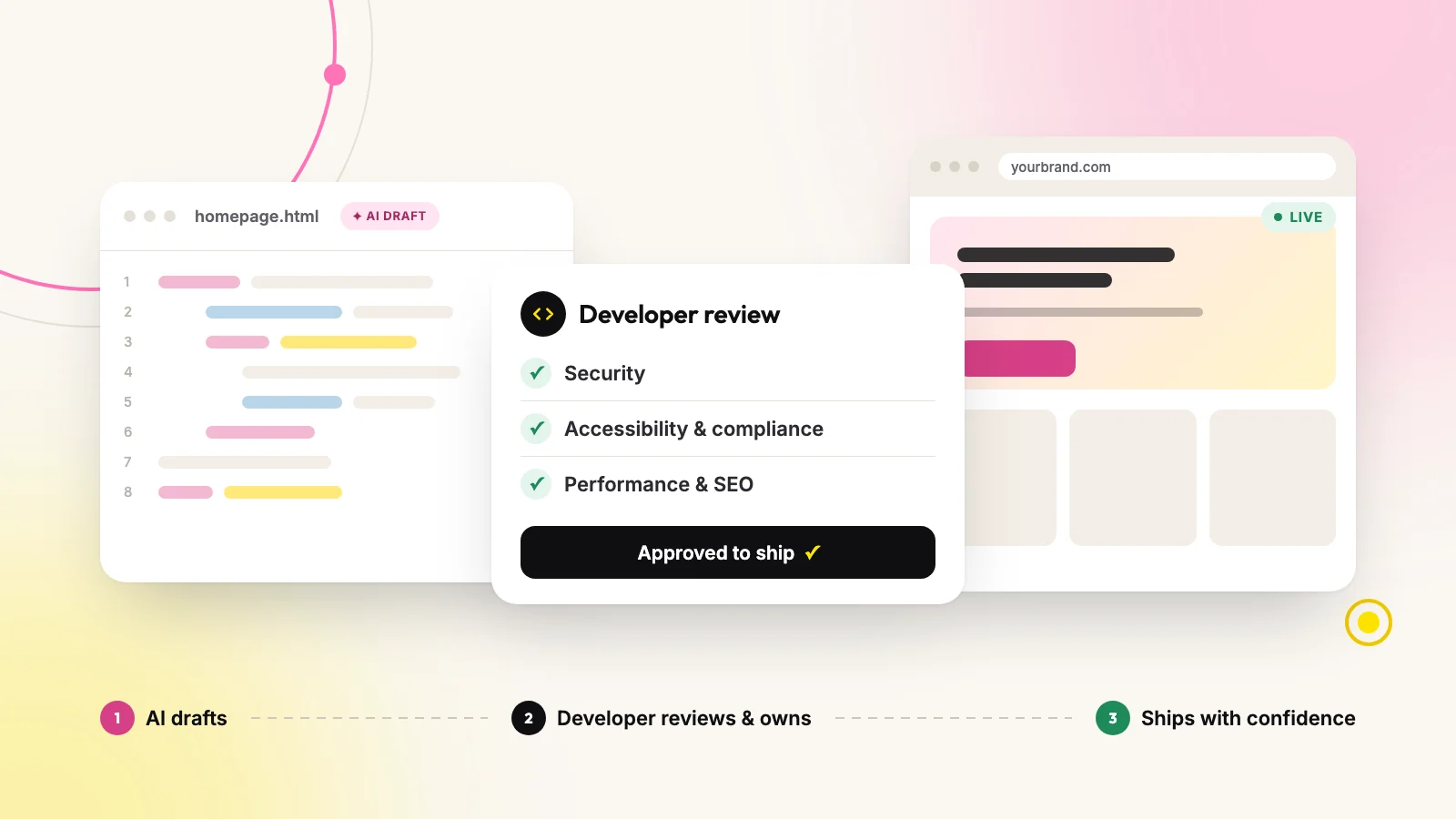
AI drafts. A developer plans, reviews, tests and owns it.
- Speed to first version
- Quality control
Best for production websites and apps
Traditional, no AI
Developers write and review everything by hand.
- Speed to first version
- Quality control
Increasingly rare, even at the largest companies
Professionals have adopted AI, not vibe coding
The industry has made its choice, and it is the middle column. Google now generates 75% of its new code with AI, but every line is “approved by engineers” (Google). Developer surveys show the same pattern: high adoption, low blind trust.
How developers feel about AI at work
Where AI speeds you up, and where it doesn’t
AI is not uniformly faster. Two careful studies point in opposite directions, and the difference is the most useful lesson in this article.
Effect of AI on task time in two controlled studies
Building an HTTP server, 202355.8% faster
Real tasks, early-2025 tools19% slower
AI shines on clear, self-contained, routine work. It helps least with nuanced changes to complex systems, which is exactly where experienced developers earn their keep. In February 2026, METR reported that developers are likely faster with newer tools, while warning that its new data could not reliably show by how much (METR 2026).
Vibe coding risks: where developers make the difference
Security risks
Share of AI-generated code samples that failed security tests
Real incidents show what this looks like. A researcher reported that 170 of 1,645 apps he scanned that were built with the AI app builder Lovable left users’ data reachable by outsiders (CVE-2025-48757; SecurityOnline). Lovable disputes responsibility, saying each customer must protect their own app’s data. And in July 2025, SaaStr’s founder reported that Replit’s AI agent deleted a production database during a code freeze (TechTarget). Either way, the website owner carries the risk.
Accessibility, compliance and speed
of the top one million home pages have detectable accessibility (WCAG) failures, averaging 56.1 errors per page.
WebAIM Million, 2026retail conversions from making a mobile site just 0.1 seconds faster, across 37 brand sites.
Deloitte, commissioned by GoogleWebAIM suggests that rising page complexity likely reflects, among other things, AI-assisted “vibe coding”, though it does not claim this as a proven cause. Accessibility is also a legal question: in the EU, the European Accessibility Act has applied to many digital products and services, including e-commerce, since 28 June 2025 (European Commission). Generated code that looks right on screen can still fail a screen reader, a keyboard user or a speed test.
“AI doesn’t fix a team; it amplifies what’s already there.”
Google Cloud, 2025 DORA Report
DORA found that AI adoption now goes with higher delivery throughput but still with lower delivery stability (DORA 2025). Strong developer practices are what turn that speed into reliable releases.
The AI-assisted development workflow
This is what upgrading traditional development with AI looks like in practice. The developer stays accountable at every step; AI removes the slow, repetitive parts.
- DeveloperPlanScope, architecture, standards, risks
- AIDraftComponents, boilerplate, tests, docs
- DeveloperReviewReads, fixes and understands every change
- Tools + developerCheckSecurity, accessibility, Core Web Vitals
- DeveloperShipVersion control, staging, then production
- AI + developerMaintainUpdates, monitoring, improvements
AI accelerates
- Scaffolding pages and components
- Boilerplate, forms and schema markup
- First drafts of tests and documentation
- Migrations and refactoring suggestions
- Explaining unfamiliar code
The developer owns
- Architecture and platform choices
- Security and data protection
- Accessibility and compliance
- Performance budgets and SEO
- Final review and accountability
AI website builder or professional development? Match the approach to the risk
Not every project needs the same level of control. The more your site handles customers, data and revenue, the more the developer should lead.
What to do, and what to avoid
Do
- Use AI for drafts, boilerplate, tests and migrations
- Review every change before it goes live
- Run security, accessibility and speed checks
- Keep code in version control, with backups
- Separate development from production
- Measure conversions, speed and defects
Avoid
- Shipping code nobody on the team can explain
- Pasting keys or customer data into AI tools
- Giving AI agents direct production access
- Assuming newer models are automatically safer
- Trusting a demo over real testing
- Building more than you can maintain
So, will AI replace web developers?
Not on the evidence so far. AI has not made developers obsolete. It has made good developers faster. The data shows AI speeds up the routine work, while human review protects the things that matter most to a business website: security, accessibility, compliance, performance and long-term maintainability.
That is how we work at RoundPatch. Our senior team uses AI throughout our website development and web application projects, and a developer reviews, tests and owns every change before it reaches your visitors. For more evidence, read AI coding assistants: what the data actually says and our AI-assisted website QA checklist.